Spelling Bee: Spelling Quiz
Happy-verseTrivia
4.5284.00 Reviews
- Version
- 6.0
- Installs
- 500.00K
- Age Rating
- Everyone
Screenshots
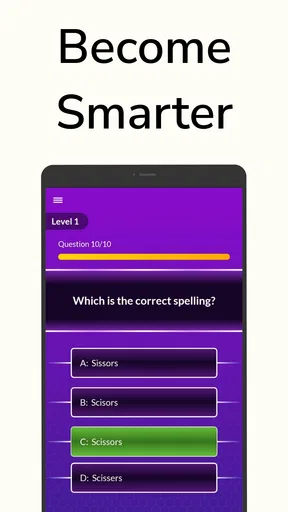
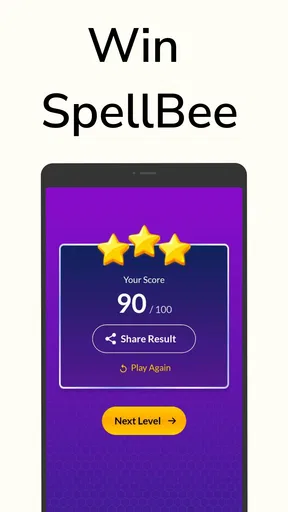
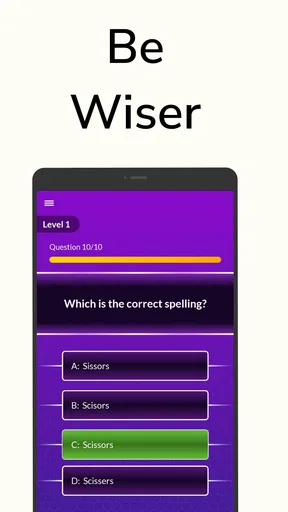
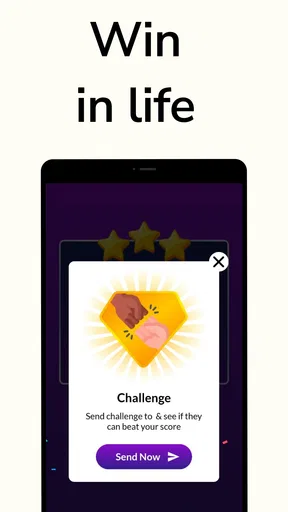
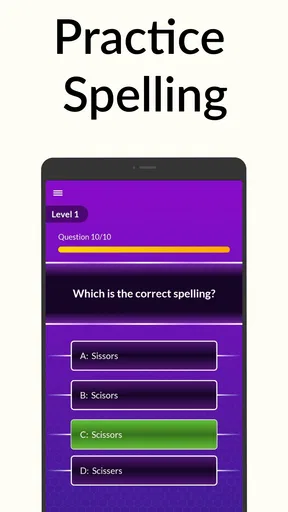
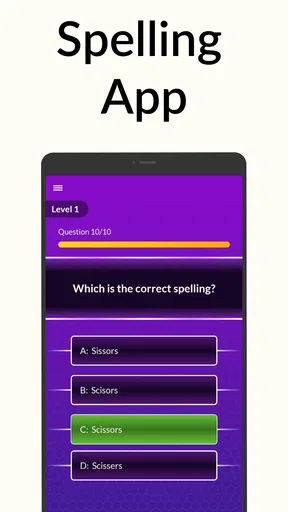
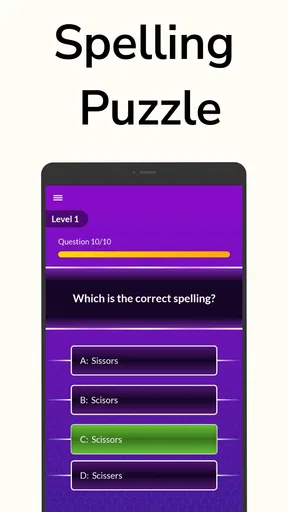
Our Review of Spelling Bee: Spelling Quiz
 Analysis by Appyee
I tried Spelling Bee: Spelling Quiz as a quick English practice game rather than as a formal language course, and that distinction matters. Its appeal is immediate: you see a spelling challenge, make a choice or enter an answer, and get a small mental workout without needing to plan a lesson. For someone who enjoys trivia and wants to keep English words active in daily life, that simplicity is the main attraction.
The game comes from Happy-verse and sits in the trivia category. It is free to start, aimed at Everyone, and has reached over 500 thousand installs. Its average rating is 4.6 from around 4.2 thousand ratings, which fits my impression that the basic idea is easy to understand and satisfying in short sessions. The more important question, though, is whether it remains useful after the first few rounds feel fresh.
From quick novelty to a repeatable spelling habit
I find that a spelling game becomes more useful when I give each short session a purpose, rather than treating a run of answers as progress by itself. A simple note of words that made me hesitate can turn a quick novelty into a repeatable habit, and it gives me a way to check what I actually remember later. That practical routine also helps frame the next question: how much pressure should a spelling challenge create?
Why the first week feels approachable
The first few sessions work because the game removes most of the usual barriers to studying. I do not have to open a textbook, choose a lesson, or decide which vocabulary list deserves attention. I can simply play when I have a spare moment. That makes it a natural fit for a commute, a short break, or the few minutes before bed when a full study session feels unrealistic.
I also like the way a spelling quiz creates a different kind of attention from ordinary word games. Recognizing a word is not always the same as spelling it correctly, so the challenge exposes gaps that can remain hidden when I only read English. A word may look familiar while still causing hesitation when I have to recall its letters. That small moment of uncertainty is where the game can become useful.
For a beginner, the format is less intimidating than writing a paragraph or speaking with another person. For an intermediate learner, it can work as a light maintenance tool. Native English speakers may enjoy it as trivia, especially if they like testing themselves on words that are easy to recognize but surprisingly difficult to spell. I would not treat it as a complete learning program, but I found it more purposeful than a purely disposable quiz.
One practical tip is to resist the urge to rush through every prompt. When I miss a word, the valuable part is not merely seeing the correct answer. I pause and look at the exact point where my memory failed: a doubled consonant, an unusual vowel pattern, or a silent letter. That turns a quick mistake into a tiny review activity. Without that pause, it is easy to collect answers without retaining much.
How I would use it during an ordinary day
Imagine having a few minutes before a meeting or while waiting for a friend. I would play a short session, then note one or two unfamiliar words in a separate vocabulary list. Later, I would try to use those words in a sentence or look for them while reading. This two-step routine is more effective than relying on the game alone, because spelling recall improves when a word is connected to meaning and context.
That workflow also shows the app’s limits. It gives me a prompt and a result, but the deeper work of understanding a word belongs elsewhere. If I need pronunciation, example sentences, grammar explanations, or conversation practice, I would switch to a dictionary, reading app, or structured language course. The quiz is best used as the recall stage of a broader routine, not as the entire routine.
The free entry point helps with experimentation. I can see whether the challenge suits me before committing to a study habit. In-app purchases range from around five dollars to nineteen dollars per item, so I would pay attention before confirming anything. The free version is the sensible starting point for casual players, while a committed user should decide whether any paid option genuinely improves their personal routine rather than buying simply because the first sessions were enjoyable.
What changes after the novelty fades
During the first week, almost any short quiz can feel rewarding because the interaction is new and every correct answer gives a clear sense of progress. After that, the standard becomes higher. I start asking whether the game helps me remember difficult words tomorrow, next week, and later in the month. That is where Spelling Bee: Spelling Quiz becomes more dependent on how deliberately I use it.
The app does not need to replace a serious course to earn a place on my phone. A five-minute maintenance tool can be worthwhile if it makes me return regularly. Its strongest long-term role is as a low-pressure reminder to keep spelling active. I would open it between more demanding activities, not expect it to carry my entire English improvement plan.
My best approach would be to create a small personal cycle. I would play until I encounter a few troublesome words, write them down, and revisit them outside the game. On the next session, I would focus on whether those spellings feel more automatic. This makes the app part of a feedback loop instead of a stream of disconnected rounds. It also prevents me from confusing a high quiz score with lasting mastery.
Who gets recurring value from it
The game is a good match for people who enjoy trivia but want each session to have a practical side effect. It also suits English learners who already have other resources and need a lightweight way to exercise spelling recall. Parents or teachers looking for a simple, age-appropriate word activity may find the Everyone rating reassuring, although I would still choose words and session length according to the learner’s level.
It is less suitable for someone who wants a carefully sequenced curriculum. If your goal is measurable progress through grammar, listening, pronunciation, and conversation, a dedicated language-learning platform will usually be the better foundation. It is also not the right choice for a player who needs detailed explanations after every error. A quiz can reveal that an answer is wrong without teaching all the reasons behind the correct spelling.
Another trade-off concerns motivation. Some people enjoy repeating short challenges and gradually reducing hesitation. Others need visible lessons, streaks, projects, or a clear path toward an exam. If you belong to the second group, the game may feel pleasant but insufficient. I would keep it as a supplement rather than force it into a role it was not designed to fill.
The maintenance burden is small, but not zero
The main maintenance advantage is that the game is easy to pick up. I do not need a long setup process or a dedicated block of time. That matters because complicated study tools often fail through friction: I intend to practice, notice several steps between me and the exercise, and postpone it. A direct spelling challenge avoids much of that problem.
Still, low friction can become low commitment. Because a session is so easy to start and stop, I can also play passively. I may answer quickly, notice a score, and move on without reviewing errors. The app does not automatically create a complete habit for me; I have to supply the reflection and repetition that make practice stick.
I would keep a simple note on my phone with difficult spellings, grouped by the reason they caused trouble. One group might contain words with silent letters, another words with confusing vowel choices, and another words I recognize but cannot produce confidently. This is a more useful personal archive than merely remembering whether I won or lost a round. It turns the game into a diagnostic tool for my own weak spots.
The current version is 5.9, and the game supports Android devices running version 5.0 or later. That broad compatibility makes it approachable for people using older phones, though the experience will still depend on the device itself. I would not choose a phone-based quiz as my primary study method if I need a distraction-free environment; notifications and the temptation to switch apps can easily break concentration.
Where fatigue can set in
The largest risk is repetition without progression. Spelling challenges are naturally compact, so the interaction can begin to feel familiar quickly. If I keep answering at the same level and never connect mistakes to real reading or writing, the activity may turn into a reflex rather than learning. The game remains enjoyable, but its educational return becomes smaller.
There is also a difference between recognizing the right spelling and producing it independently. A quiz can make me feel confident because I select the correct option, yet that confidence may not transfer to writing an email or completing a school assignment. To test whether practice is working, I occasionally write the difficult words from memory without looking at the game. That extra check reveals whether I truly learned them.
Another source of fatigue is the mismatch between challenge and ability. If the words feel too easy, I stop paying close attention. If they feel too obscure, mistakes can seem arbitrary rather than instructive. I would use the app in short bursts and stop when concentration drops. Continuing simply to accumulate more rounds is not necessarily productive, especially when the goal is accurate recall rather than a large session count.
Paid content can introduce a different kind of hesitation. Since individual in-app purchases can cost from around five dollars to nineteen dollars, I would not make a purchase based only on the excitement of the first day. I would first establish that I return to the free experience consistently and understand what additional value I am buying. For a casual player, spending may not be justified; for a regular learner, it depends on whether the extra material addresses a real need.
How it compares with familiar alternatives
Compared with a dictionary, this game is more active but less explanatory. A dictionary is better when I need pronunciation, definitions, usage notes, or examples. Compared with flashcards, the quiz is easier to begin but may give me less control over exactly which words I review. Flashcards are stronger when I want deliberate repetition of a personal list, while this game is more convenient when I want an unexpected challenge.
Compared with a full language-learning course, it is narrower and lighter. A course can connect spelling with listening, grammar, reading, and speaking, whereas this app concentrates on word spelling and trivia-style engagement. That narrow focus is a weakness if I expect comprehensive instruction, but it is a strength if I already have those areas covered and simply want a quick spelling workout.
Compared with a general word puzzle, it offers a clearer learning purpose. A puzzle may improve pattern recognition or vocabulary indirectly, but this game puts spelling at the center. I would choose it when I want to practice the exact skill that causes trouble in writing. I would choose a broader word game when I want variety, creativity, or a more relaxed challenge with no study intention.
My long-term verdict
Spelling Bee: Spelling Quiz earns lasting space for me only as a small part of a larger English habit. Its best quality is accessibility: I can turn an idle moment into focused spelling practice without preparing a lesson. The trivia format keeps the task lighter than formal study, and its free availability makes it easy to test without commitment.
Its long-term value depends on what happens after each answer. If I review mistakes, record difficult words, and use them in real sentences, the game becomes a useful maintenance tool. If I only chase correct responses and move on, the novelty fades faster and the learning effect feels shallow. That is not a reason to dismiss it; it is a reason to use it honestly.
I would recommend it to casual trivia fans, English learners who want extra spelling practice, and anyone who struggles to maintain a short daily routine with heavier apps. I would skip it as a primary choice if I need structured lessons, detailed corrections, pronunciation training, or a complete path toward fluency. In those cases, a dictionary, flashcard system, or full language course will serve me better.
Overall, Happy-verse has made a focused, approachable game rather than an all-purpose English teacher. The app’s lasting strength is not endless novelty but its ability to fit between more serious activities. Use it as a five-minute spelling checkpoint, not as your entire language plan, and it can remain useful well beyond the first week.
Privacy and Permissions
See what permissions an app requests and how it handles your data.
- Wi-Fi connection information
- view Wi-Fi connections
- Other
- view network connections, connect and disconnect from Wi-Fi, full network access, run at startup, prevent device from sleeping
Verdict
Strengths of Spelling Bee: Spelling Quiz
- Short rounds make it easy to play during quick breaks.
- Helpful hints can guide players when they get stuck.
- Vocabulary challenges suit both casual and regular players.
- Simple controls make the game accessible for most ages.
- Progress tracking encourages you to keep improving your spelling.
Limitations of Spelling Bee: Spelling Quiz
- Some puzzles may feel repetitive after extended play.
- Difficulty can vary noticeably between different rounds.
- Hints may reduce the challenge for experienced players.
- Requires concentration, which may not suit relaxed gaming sessions.
- Ads or optional purchases may interrupt the overall experience.
Similar Picks in This Category
View All
Millionaire 2026 Quiz & Trivia
Quiz & Trivia Games by Submarine Apps4.5

Brain Test 2: Tricky Stories
Unico Studio4.7

Trivia Crack: Brain Quiz Games
etermax4.4

QuizzLand. Quiz & Trivia game
Quiz & Trivia Games by Mno Go Apps4.8

Brain Test: Tricky Puzzles
Unico Studio4.7

Logo Quiz
bubble quiz games4.5
Frequently Asked Questions
What is Spelling Bee: Spelling Quiz?
Spelling Bee: Spelling Quiz is an educational word game designed to help players practice English spelling through quiz-style challenges. The app typically presents a word, pronunciation, definition, or related clue and asks you to enter or select the correct spelling. It can be useful for students, families, and anyone who wants to expand vocabulary while enjoying short, game-like practice sessions.
How does the gameplay work in Spelling Bee: Spelling Quiz?
The gameplay is based on identifying and correctly spelling words across different quiz rounds or difficulty levels. Depending on the challenge, you may hear a word, read a clue, or choose from possible answers. Correct responses usually allow you to continue, build a score, or unlock harder content, while mistakes provide an opportunity to review unfamiliar spellings and improve accuracy.
Is Spelling Bee: Spelling Quiz suitable for children and students?
The app can be suitable for children and students, especially those working on vocabulary, spelling accuracy, and English language fundamentals. However, the appropriate age depends on the word lists, difficulty settings, advertisements, and available parental controls in the current version. Parents and teachers should review the app’s store information and test a few rounds before recommending it to younger learners.
Does Spelling Bee: Spelling Quiz require an internet connection?
Internet requirements may vary depending on the version and platform. Basic spelling rounds may work offline if the necessary word content is stored on the device, but advertisements, analytics, updates, leaderboards, or additional packs may require an internet connection. Before traveling or using the app with limited data, open it in offline mode to confirm which features remain available.
Is Spelling Bee: Spelling Quiz free to download and use?
Spelling Bee: Spelling Quiz may be available as a free download, but free access can include advertisements, limited levels, optional purchases, or subscriptions for extra content. The exact pricing and features can change between Android and iOS versions. Before downloading or making a purchase, check the official store listing for current costs, in-app purchase details, privacy information, and cancellation terms.
Play our best games!


